
The League administers several awards and contests annually, from book awards to spoken word awards to single-poem contests and more. Find information about deadlines, eligibility, and submissions on this page.
Open for submissions
Book awards
Gerald Lampert Memorial Award
for a debut book of poetry
The Gerald Lampert Memorial Award is given in the memory of Gerald Lampert, an arts administrator who organized authors’ tours and took a particular interest in the work of new writers. The award recognizes a first book of poetry published by a Canadian. The award carries a $2,000 prize and is awarded annually in May.
Pat Lowther Memorial Award
for a book of poetry by a woman
This award is inclusive of cis women, trans women, and non-binary individuals who feel comfortable being recognized by a women’s prize.
The Pat Lowther Memorial Award is awarded in memory of the late Pat Lowther, whose career was cut short by her untimely death in 1975. The Pat Lowther Memorial Award carries a $2000 prize and is awarded annually in May.
Raymond Souster Award
for a book of poetry by a League member
The Raymond Souster Award honours Raymond Souster, an early founder of the League of Canadian Poets, and carries a $2000 prize, awarded annually in May.
September 2, 2025 - November 26, 2025:
Submissions are now closed.
Please note November 26 is the deadline to complete the submission form;
books can be shipped and received into December 2025.
Authors should confer with their publishers to confirm who will submit their book for consideration.
- Titles must be at least 48 pages in length, including front and back matter
- Titles must have a valid ISBN and be available for purchase through a minimum of one recognized national bookseller
- Titles must be English, or bilingual (identical content in two languages) with English as one of the languages
- Selected/collected works are eligible as long as all other eligibility criteria are met
- New or revised editions of previously published titles are not eligible
- Translations and collaborative titles are eligible as long as all authors (including translators) meet eligibility criteria
- If awarded to a book with multiple authors, the prize amount is split evenly between authors (including translators)
- For the purposes of these awards, illustrators and editors are not considered authors
- All authors (including translators) must be Canadian citizens or permanent residents
- Publishers do not need to be based in Canada
- Please submit only one (1) book per form
- Submissions will include three (3) copies of each title submitted, per award, and one (1) additional copy of each book, as well as a $25.00 submission fee per title and per award.
- Fee reductions are available for books authored by BIPOC and/or LGBTQI2S writers.
- Books must be submitted as hard copies, with PDFs accepted only for exceptional circumstances. Please contact admin@poets.ca to inquire.
Submissions open annually in September, for books published December (previous year) - November (current year).
Spoken Word awards
LCP Spoken Word Award
The LCP Spoken Word Award submissions open twice annually, in June and November.
The summer submission window is open now until August 13, 2026.
Launched in winter 2023, the $500 LCP Spoken Word Award celebrates a single poem or suite of poems up to 10 minutes in length.
The award celebrates the wide range of styles represented within the spoken word genre, from dub poetry to spoken word poetry to sound poetry and beyond. By running twice per year, this prize will recognize two poems or suites of poems that represent two distinct schools of spoken word poetry.
The summer submission window welcomes poems that center the performance, structure, and artistry of spoken word without any multi-media creativity (eg. videos do not have additional audio or visual effects or accompaniment).
The winter submission window welcomes poems with additional multi-media creativity (eg. videos contain audio and/or visual effects or accompaniment).
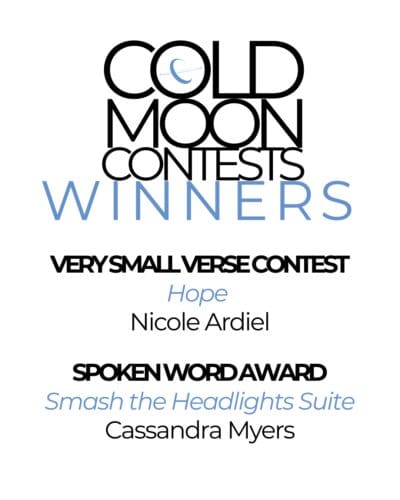
2026 Cold Moon Contest winners
Join the League of Canadian Poets in congratulating Nicole Ardiel and Cassandra Myers, winners of the 2026 Cold Moon Contests!
The LCP Spoken Word Award summer submission window is open from June 4 to August 13, 2026.
- This prize is open to spoken word and poetry performance artists in the country colonially known as Canada, or Canadian artists living abroad (Please note: prize payments can only be made to Canadian or US bank accounts).
- Submissions are accepted in any language (no translation required).
- Open to poets at any stage of their career.
- Limit one entry per poet.
- There is a $5 entry fee for this award. If you are facing financial barriers and are unable to pay the full contest fee, please find information about a discounted fee on the submission form.
- This award has been created to celebrate the specific art of spoken word and performance poetry: that is, poems that have been constructed with the specific intent of being read or performed aloud. Submissions and the artist’s statement should reflect this intent.
- Please note that spoken word and performance poetry do not need to be memorized to be performed.
Your artist statement is likely to be between 100 and 500 words and should contain information about your submission that may help contextualize your performance to the jurors. This could include stylistic influences, cultural influences, or an explanation of artistic choices. This may also include information about yourself as an artist, and what you drew from to create the piece that you’ve submitted.
Artist statement example:
This suite of poems, titled “But you don’t seem—,” is an exploration of identity and perception, inspired by the poet’s own experiences as a queer, autistic artist and professional. Each poem presents a dichotomy between the speaker’s internal experience in a particular setting—a classroom, an office, a social event—and their external environment and feedback. Each poem builds on the experience of the last, using sound and voice effects to amplify the simulation of overstimulation, sensory overload, and burnout. The final poem nearly departs from linguistic communication altogether to represent the experience of a meltdown, bouncing between the highly internal experience of the speaker to the supposed external perception of a viewer.
Your artist bio will likely be between 75 and 300 words, but may be less. This should be a summary of your experience as an artist – it could include your location and aspects of your identity, but it doesn’t need to. You may simply wish to list a few relevant achievements, such as feature performances, education, or community involvement.
Artist bio example:
Nic Brewer is a queer, autistic writer and editor from Toronto. She writes fiction, mostly; her first novel, Suture, was published by Book*hug in Fall 2021. She is the co-founder of Frond, an online literary journal for prose by LGBTQI2SA writers, and formerly co-managed the micropress words(on)pages. She doesn’t look like her author photo, doesn’t have an MFA, and really wants to hear about what you love most in the world. She lives in Kitchener with her wife and their dog.
All submissions will be evaluated on the following rubric:
- Artistic value /10 – poetics
- Performance /10 – note that this is not production, and poems do not need to be memorized
- Cultural value /5 – relevance in the world, from the macro (global) to the micro (communities, municipalities, regions, etc.)
- Originality /5 – artistic risk, new ideas
Lillian Allen Prize & the Lillian Allen Emerging Artist Prize
In 2024 the Ontario Arts Council, in partnership with the League of Canadian Poets, created the Lillian Allen Prize and the Lillian Allen Emerging Artist Prize to recognize and celebrate spoken word poetry.
The prizes are named after Canadian poet and spoken word artist Lillian Allen. Her distinctive approach to poetry through language, music and social consciousness continues to capture attention and make change. She embodies the excellence, creativity, and professionalism that she has brought to the form, and we recognize her community building and generosity of spirit by naming this prize in her honour.
The Lillian Allen Prize supports and promotes a spoken word artist with five or more years’ experience, and the Lillian Allen Emerging Artist Prize is for a spoken word artist with less than five years’ experience.
Prize: Two prizes of $2,000
These annual prizes will alternate between recognizing poets based in Ontario and in Canada. In year one the prizes will recognize poets in Ontario, and in year two the prizes will recognize poets based anywhere in Canada.
Le prix Lillian Allen et le prix Lillian Allen de la relève
Le Conseil des arts de l’Ontario, en partenariat avec la Ligue des poètes canadiens (LPC), a créé ces prix en 2024 pour récompenser et célébrer la poésie orale.
Les prix portent le nom de Lillian Allen, poète canadienne et artiste de la création parlée. Son approche particulière de la poésie par l’entremise du langage, de la musique et de la conscience sociale continue de captiver les esprits et d’entraîner le changement. Lillian Allen incarne les qualités qu’elle a apportées à la poésie orale – excellence, créativité, professionnalisme – et nous avons nommé ces prix en son honneur pour rendre hommage à son sens de la communauté et à son esprit de générosité.
Le prix Lillian Allen récompense une ou un poète ayant au moins cinq ans d’expérience, et le prix Lillian Allen de la relève récompense une ou un poète ayant moins de cinq ans d'expérience.
Montant: Deux prix de 2 000 $ chacun
Les prix récompenseront en alternance des poètes établis en Ontario et au Canada. La première année, les prix récompenseront des poètes de l'Ontario et, la deuxième année, des poètes établis où que ce soit au Canada.
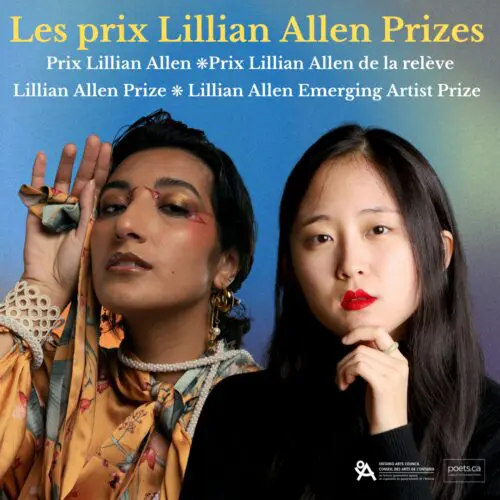
Prix Lillian Allen Prizes: 2024 winners / gagnants
Join the League of Canadian Poets in congratulating the winners of the 2024 Lillian Allen Prizes! Célébrez les gagnants du 2024 Prix Lillian Allen!
Year 1 eligibility: Ontario Spoken Word Artist
Nominees must:
- be individual, professional artists, 18 years of age or older
- live in Ontario have lived in Ontario for at least 12 consecutive months before the nomination deadline
- be Canadian citizens or permanent residents of Canada, or have an application pending for permanent resident status
- submit all documentation in English or French
Year 2 eligibility: Canadian Spoken Word Artist
- be individual, professional artists, 18 years of age or older
- live in Canada
- have lived in Canada for at least 12 consecutive months before the prize deadline
- be Canadian citizens or permanent residents of Canada, or have an application pending for permanent resident status
- submit all documentation in English or French
Ineligibility
-
Previous laureates of the Lillian Allen Prize or the Lillian Allen Emerging Artist Prize cannot be nominated again for the same prize. However, previous Lillian Allen Emerging Artist Prize laureates can be nominated for the Lillian Allen Prize once they meet its eligibility criteria.
-
Elected federal, provincial and municipal representatives, and members of the judiciary, are not eligible while in office.
-
No person shall be awarded posthumously unless death occurs after the laureate has been selected.
The League of Canadian Poets is dedicated to increasing the accessibility of our programs and services; if you are unable to complete your submission as outlined below, please contact admin@poets.ca.
Submissions will require:
- A portfolio of work up to 20 minutes in length – accepted as 1-5 video files or 1-5 video links (e.g. Youtube, Vimeo)
- An artist statement on portfolio of work (up to 750 words in length)
- An artist CV, including performance history, community engagement, and education
Submissions should not include audio or video effects that would not be replicated in a live performance.
Submissions may include original music if it would be included in the live performance of the poem(s).
Limit of one (1) submission per poet.
Please note: Submissions that significantly exceed the posted limits in any area will disqualify the entire submission.
Nomination by a Third Party
Anyone can nominate an eligible poet; nominees will be contacted by LCP and will be invited to submit material for consideration (see submission requirements above)
The nomination deadline is 11:59pm ET on June 30, 2025.
Self Nomination (Submission)
Any eligible poet may self-nominate by submitting directly to the prize. The EXTENDED submission (self-nomination) deadline is 11:59pm ET on August 7, 2025.
Note on Nominations
- There is no benefit to multiple nominations for a poet. Only one submission is considered.
- Each poet may submit one submission only for the consideration of the assessment panel. In the case of multiple submissions, the earliest (first) timestamped submission is chosen.
Artist statement (max 750 words)
Your artist statement is likely to be between 300 and 700 words and should contain information about your submission to help contextualize your body of work for the jurors. This could include stylistic influences, cultural influences, or an explanation of artistic choices. The statement may also include information about yourself as an artist, and what you drew from to create the piece or pieces that you’ve submitted.
Examples:
Example: The portfolio submitted with this application is a selection of recent work, most of which explores identity and perception, inspired by my own experiences as a queer, autistic artist and professional. Early influences for this work include Sabrina Benhaim and Spencer Butt, for their unflinching approach to performing about mental illness. This portfolio showcases recent work, because the shape of my work has changed significantly since first coming out as gay, and then receiving my autism diagnosis: where my work used to point outward, asking listeners to open their minds, demanding more of my audiences, my work now is distinctly personal. I no longer want to ask anything of my listeners; instead, my poems try to articulate the inarticulable, and it is simply a gift if my audience finds something of themselves or their loved ones in those articulations. When my existence became political, my poetry turned away from its previous loud and noble stances in favour of tenderness for those bodies and minds that may struggle to find a soft place to land in our increasingly hostile society.
CV
Your CV for this prize should clearly summarize your recent history with spoken word poetry. Poets submitting to the 5+ years experience category should be sure to include examples of work and performance history that reflect the 5+ years.
Include year, city, and venue (as appropriate).
Your CV does not need to be formatted in any special way, but should be clearly separated into categories; we suggest performance history, community engagement, and education.
Performance history should include a comprehensive list of your major performances; you do not need to list every performance you’ve ever done.
Community engagement should indicate events you have hosted or organized within the spoken word community.
Education should outline such opportunities as residencies, classes, courses, or mentorships that you have either attended or facilitated. For instance, include if you’ve hosted a workshop for spoken word poets, been mentored by a prominent spoken word artist or mentored an artist.
Example:
[Your name and contact details]
Performance History
- [Name of show], [Date] - [Performance description]
- Hot Damn It’s a Queer Slam, January 13, 2023 - Feature poet set (only feature poet)
- Death Rides a Unicorn, November 20, 2022 - Feature set (multiple features)
- Toronto Poetry Slam, August 13, 2021 - Slam participant (winner)
Community engagement
- Host and organizer, Introverts Try Slam series (Nov 2022 – present)
- Founder, words(on)stages reading series (Nov 2016 – Nov 2018)
- Organizer, Poets for #BlackLivesMatter (June 14, 2019)
Education history
- September 2023: Mentor to Junior McPoet
- December 2022: Banff residency
- July 2022: Mentorship with Poet McSlammerson
All submissions will be evaluated on the following rubric:
-
Body of work /35
-
Artistic value /10 – poetics
-
Performance /10 – note that this is not production, and poems do not need to be memorized
-
Cultural value /10 – relevance in the world, from the macro (global) to the micro (communities, municipalities, regions, etc.)
-
Originality /5 – artistic risk, new ideas
-
-
Community engagement /5
-
Mentorships
-
Education, workshops
-
Community organizing
-
Event hosting and organizing
-
Lillian Allen is an acclaimed foremother of Canadian Poetry.
A poet, writer/performer, and a long-time arts activist, she is a leading international exponent of dub poetry with its politically charged reggae-infused aesthetic of resistance and poetic calls for justice, peace, joy, pleasure and revolution. Lillian is Toronto’s 7th Poet Laureate and has an Honourary Doctor of Letters from Wilfrid Laurier University for her significant contribution and impact on Canadian literature.
Lillian has also been a successful Cultural Strategist, impacting at the international level as a member of the executive of the Canadian Commission for UNESCO and its Sectorial Commissions, and advising three levels of government, and played a key role in transforming the Toronto and Canadian cultural landscapes. A mentor for individuals and groups across many cultures, she brings her critical and effective equity and community building strategies to institutions such as OCAD University and the Toronto Arts Council. A creative writing professor at OCAD University, she initiated and led the development of a BFA in Creative Writing Program that acknowledges community connected writing, traditional, non-traditional and new writing forms.
Over the decades, she created opportunities for new generations of artists and initiated and led community-building youth-supporting arts programs such as Fresh Elements and Fresh Arts. She has mentored dozens of artists and cultural workers and received numerous accolades, citations and awards. She is the recipient of the Toronto Cultural Champions Award, the Margo Bindhardt Award for significantly impacting the arts in Toronto through both creative work and activism, and the William P. Hubbard Award for Race. She has delivered numerous lectures, and was Vancouver Island University’s 2020-21 Gustafson Distinguished Poet.
Lillian continues to artistically push the boundaries of poetry and the possibilities for language as she continues to inspire generations of young people. Her newest collection is Make the World New, WLU Press 2021. Other books include Women Do this Every Day, Psychic Unrest, plus books and recordings for children and young people. Also, a globally recognized recording artist, Ms. Allen is a two-time Canadian Juno award winner for her recordings Conditions Critical and Revolutionary Tea Party, which was recently nominated for the prestigious Polaris Heritage Prize in Canada.
Admissibilité pour l’année 1 : artistes de la création parlée de l’Ontario
Les proposants doivent :
- être des artistes professionnels âgés d’au moins 18 ans
- vivre en Ontario
- avoir vécu en Ontario pendant au moins 12 mois consécutifs avant la date limite de la candidature
- être citoyens canadiens ou résidents permanents du Canada, ou avoir fait une demande de statut de résident permanent
- soumettre la documentation exigée en anglais ou en français
Admissibilité pour l’année 2 : artistes de la création parlée du Canada
Les proposants doivent :
- être des artistes professionnels âgés d’au moins 18 ans
- vivre au Canada
- avoir vécu au Canada pendant au moins 12 mois consécutifs avant la date limite de la candidature
- être citoyens canadiens ou résidents permanents du Canada, ou avoir une demande de statut de résident permanent en cours
- soumettre la documentation exigée en anglais ou en français
Inadmissibilité
- Les lauréats précédents du prix Lillian Allen ou du prix Lillian Allen de la relève ne peuvent pas être proposés à nouveau pour le même prix. Toutefois, les anciens lauréats du prix Lillian Allen de la relève peuvent être proposés pour le prix Lillian Allen s’ils répondent aux critères d’admissibilité de ce dernier.
- Les représentants élus au palier fédéral, provincial et municipal ainsi que les membres de la magistrature ne sont pas admissibles pendant la durée de leur mandat.
- Le prix ne sera pas attribué à titre posthume, sauf si le décès survient après que le lauréat a été sélectionné.
La Ligue des poètes canadiens vise à rendre ses programmes et services plus accessibles. Si vous ne pouvez pas soumettre le dossier de candidature tel qu’il est décrit ci-dessous, veuillez communiquer avec nicole@poets.ca.
Le dossier de candidature doit comprendre :
- un portfolio d'œuvres d'une durée maximale de 20 minutes – acceptées sous la forme de 1 à 5 fichiers vidéo ou de 1 à 5 liens vidéo (YouTube, Vimeo, par exemple)
- une déclaration d’artiste (750 mots maximum)
- un CV artistique, qui comprend notamment l'historique des performances, l'engagement communautaire et la formation (voir exemple ci-dessous)
Les œuvres soumises ne doivent pas inclure des effets audio ou vidéo qui ne seraient pas reproduits lors d'une performance en direct.
Elles peuvent inclure de la musique originale si celle-ci fait partie de la performance en direct.
Limite d'une seule soumission par poète.
Remarque : Si la documentation soumise dépasse considérablement les limites décrites ci-dessus, la candidature entière sera refusée.
Mise en candidature par un tiers
Tout le monde peut proposer la candidature d'un poète admissible. La Ligue des poètes canadiens contactera les candidats et les invitera à soumettre un dossier.
La date limite des mises en candidature est le 30 juin à 23h59.
Autocandidature
Tout poète admissible peut proposer sa propre candidature en utilisant la plateforme de soumission.
La date limite des autocandidatures et soumissions est le 7 août à 23h59.
Remarque sur les mises en candidature
- Il n'y a aucun avantage à proposer plusieurs fois la candidature du même poète à la même date limite. Une seule candidature est examinée.
- Chaque poète ne peut soumettre qu'une seule candidature au groupe d’évaluation. En cas de multiples soumissions, c'est la première qui est retenue.
Déclaration d'artiste (750 mots maximum)
Votre déclaration d'artiste devrait compter de 300 à 700 mots et contenir des informations sur votre candidature afin d'aider les à placer votre œuvre dans son contexte. Il peut s'agir d'influences stylistiques ou culturelles, ou d'une explication de vos choix artistiques. La déclaration peut également contenir des informations sur vous-même en tant qu'artiste et sur les éléments qui vous ont permis de créer l'œuvre ou les œuvres soumises.
Exemple : « Le portfolio soumis avec cette candidature contient une sélection d’œuvres récentes qui explorent pour la plupart l'identité et la perception, et s’inspirent de mes propres expériences en tant qu'artiste professionnel queer et autiste. Mon travail a été influencé au départ par l’approche franche et directe de la maladie mentale adoptée par Sabrina Benhaim et Spencer Butt. Ce portfolio présente des travaux récents, car ma démarche a considérablement changé depuis que j'ai révélé mon homosexualité et été diagnostiqué autiste : alors qu’auparavant mon travail s'orientait vers l'extérieur et était assez exigeant, demandant entre autres au public de faire preuve d'ouverture d'esprit, mon travail est maintenant beaucoup plus personnel. Je ne veux plus rien exiger de mon public. Je cherche plutôt à exprimer l'inexprimable dans mes poèmes, en espérant que mes auditeurs y trouvent quelque chose d'eux-mêmes ou de leurs proches. Lorsque mon existence est devenue politique, ma poésie a délaissé ses prises de position fracassantes pour se tourner avec tendresse vers ces corps et ces esprits qui peinent à trouver un point d'ancrage dans une société devenue de plus en plus hostile. »
Exemple : « Les œuvres soumises dans ce portfolio s'étalent sur plus de deux décennies et retracent mon parcours artistique du point de vue forme, son et langage. En les écoutant, vous pourrez suivre l'évolution d'un étudiant, d'un rêveur et d'un artiste, et j'espère que vous serez aussi fasciné que moi par ce cheminement. Les poèmes représentent chacun une étape : dans les premières années, ils adoptent la narration magistrale du slam pour faire résonner l'urgence et la justice; plus tard, cette même culture se trouve rejetée dans des poèmes aux sonorités cycliques et insulaires qui frôlent les limites du langage; plus tard encore, les poèmes concilient ces limites et explorent la façon dont les failles du langage peuvent être compensées par une collaboration multimodale. J'espère que cette trajectoire vous donnera l’occasion de réfléchir au pouvoir de chaque genre, à ses limites et à son potentiel de changement, d'inspiration et de collaboration. »
CV
Votre CV pour ce prix doit résumer clairement votre expérience récente en matière de poésie orale. Les poètes qui soumettent leur candidature dans la catégorie « Expérience de 5 ans et plus » doivent veiller à inclure des exemples d’œuvres et de performances qui reflètent leur d'expérience de 5 ans et plus.
Indiquez l'année, la ville et l’endroit (selon le cas).
Votre CV ne doit pas être formaté d'une manière particulière, mais il doit être clairement divisé en catégories; nous vous suggérons l'historique des performances, l'engagement communautaire et la formation.
Historique des performances : Énumérez toutes vos performances principales. Ce n'est pas nécessaire d’indiquer celles qui ne le sont pas.
Engagement communautaire : Énumérez les évènements que vous avez accueillis ou organisés dans le milieu de la création orale.
Formation : Indiquez les activités – résidences, classes, cours, mentorats – auxquelles vous avez participé ou que vous avez dirigées. Par exemple, indiquez si vous avez organisé un atelier pour des artistes de la création parlée, si vous avez été mentoré par un artiste de la création parlée reconnu ou si vous avez mentoré un artiste.
Exemple:
[Votre nom et vos coordonnées]
Historique des performances
- [Nom du spectacle], [date] – [description du spectacle]
- Un pas pire slam queer, 13 janvier 2023 – artiste invité (seul artiste invité)
- La mort à dos de licorne, 20 novembre 2022 – artiste invité (plusieurs artistes invités)
- Toronto Poetry Slam, 13 août 2021 – Slameur participant (lauréat)
Engagement communautaire
- Hôte et organisateur de la série Les introverti·e·s essaient le slam (depuis novembre 2022)
- Fondateur de la série de lectures mots(sur)scène (novembre 2016 à novembre 2018)
- Organisateur, Poètes pour #BlackLivesMatter (le 14 juin 2019)
Formation
- Septembre 2023 : ai mentoré Junior Poèteau
- Décembre 2022 : résidence à Banff
- Juillet 2022 : mentorat auprès de Poète Slammeureux
- Ensemble de l’œuvre /35
- Valeur artistique /10 – poétique
- Performance /10 – noter qu’il ne s’agit pas de production et que les poèmes ne doivent pas être mémorisés
- Valeur culturelle /10 – de la macropertinence (échelle mondiale) à la micropertinence (communauté, municipalité, région, etc.)
- Originalité /5 – risques artistiques, nouvelles idées
- Engagement communautaire /5
- Mentorats
- Formation, ateliers
- Organisation du milieu
- Accueil et organisation d’évènements
Lillian Allen est une pionnière reconnue de la poésie canadienne.
Poète, parolière-performeuse et militante artistique chevronnée, elle est l’une des principales représentantes internationales de la poésie dub, avec son esthétique de résistance et ses appels poétiques à la justice, à la paix, à la joie, au plaisir et à la révolution. Lillian, septième poète officielle de la Ville de Toronto, a reçu un doctorat honorifique en lettres de l’Université Wilfrid Laurier pour son influence considérable sur la littérature canadienne et son importante contribution à celle-ci.
Lillian a également été une stratège culturelle accomplie qui a exercé une influence considérable sur la scène internationale en tant que membre du comité exécutif de la Commission canadienne pour l’UNESCO et de ses commissions sectorielles. Elle a aussi conseillé trois paliers de gouvernement et a joué un rôle déterminant dans la transformation du paysage culturel de Toronto et du Canada. À titre de mentore pour des particuliers et des groupes de la diversité, elle apporte ses stratégies critiques et efficaces en matière d’équité et de cohésion sociale à différents établissements, dont l’Université de l’EADO et le Conseil des arts de Toronto.
Professeure de création littéraire à l’Université de l’EADO, Lillian Allen a instauré et dirigé le développement d’un programme de baccalauréat en beaux-arts axé sur la création littéraire, programme qui intègre les formes d’écriture liées au milieu communautaire aussi bien que les formes traditionnelles, non traditionnelles et nouvelles.
Au fil des décennies, elle a créé des débouchés pour de nouvelles générations d’artistes. Elle a notamment lancé et dirigé Fresh Elements et Fresh Arts – programmes artistiques communautaires destinés à la jeunesse – et a encadré des dizaines d’artistes et de travailleurs culturels. Elle a reçu de nombreux honneurs, distinctions et prix, notamment le prix Cultural Champion de la Ville de Toronto, le prix Margo Bindhardt pour l’influence considérable de son travail créatif et de son activisme sur les arts à Toronto, le prix William P. Hubbard pour l’amélioration des relations interraciales. Lillian Allen a prononcé de nombreuses conférences et a été déclarée Gustafson Distinguished Poet par l’Université de l’île de Vancouver pour l’année 2020-2021.
Sur le plan artistique, Lillian continue de repousser les limites de la poésie et les possibilités du langage tout en continuant d’inspirer des générations successives de jeunes. Son dernier recueil s’intitule Make the World New (WLU Press, 2021), et la liste de ses ouvrages comprend Women Do this Every Day, Psychic Unrest, ainsi que des livres et des enregistrements pour la jeunesse. La renommée mondiale de Lillian Allen n’est plus à faire, et ses enregistrements lui ont valu deux prix Juno : Conditions Critical et Revolutionary Tea Party. Ce dernier figurait en 2022 parmi les finalistes du prestigieux Prix du Patrimoine Polaris de la famille Slaight.
Contests and prizes
Pamela Paige Porter Poetry Prize
The Pamela Paige Porter Poetry Prize (PPPPP) submissions open annually in November.
The PPPPP awards an annual prize of $2,000 to a book-length collection of poetry that demonstrates a masterful execution of the themes of the beauty and meaning found in everyday life, empathy and connection to nature, wonder in creation, celebration of the natural world, grief in witnessing the destruction of nature, and hope for healing and conserving the environment we all share – all themes that are present in the work of Pamela Porter.
This unique poetry contest celebrates book-length poetry collections (published or unpublished) and honours both emerging and established poets. This prize accepts only anonymous submissions, ensuring unbiased evaluation of each work.
This contest is open to submissions from poets who live or work in Canada only.
Submissions previously considered may be submitted again to this contest in subsequent years.
Submitted collections:
-
Must fit the theme of the Pamela Paige Porter Annual Poetry Contest, demonstrating a masterful execution of the themes of the beauty and meaning found in everyday life, empathy and connection to nature, wonder in creation, celebration of the natural world, grief in witnessing the destruction of nature, and hope for healing and conserving the environment we all share.
-
May be previously published or unpublished.
-
Must be book-length, including 25-90 pages of poetry. Font should be a size 10-12 in a standard font, such as Calibri, Aptos, Times New Roman, etc.
-
Must be submitted in a single PDF file with a title page.
-
Should contain no identifying information anywhere in the collection or the filename
-
May optionally include a table of contents.
-
Must be submitted in English for evaluation. Collections may have been published or originally written in another language, but a translation to English is necessary for this contest.
We regret that our jurors cannot provide personalized feedback on collections submitted to this contest.
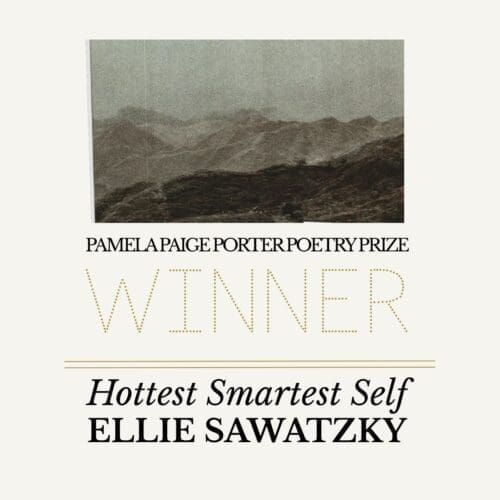
2026 Pamela Paige Porter Poetry Prize: Winner Announcement
Join the League of Canadian Poets in celebrating the 2026 winner of the Pamela Paige Porter Poetry Prize!!
Very Small Verse Contest
The Very Small Verse Contest submissions open annually in November.
The Very Small Verse Contest invites and challenges poets to submit a poem at least six (6) words in length but no more than two hundred (200) characters, excluding spaces and title.
The winner will receive $300, publication in the annual Poem In Your Pocket Day Booklet, as well as have their poem professionally designed and printed on a T-Shirt or tote bag.
- Poems must be previously unpublished and at least 6 words in length to a maximum of 200 characters, excluding spaces and title.
- You may submit one poem per submission/submission fee.
- Fees are $2.50 for League members and $5 for non-members.
- You may submit multiple times, but please note the submission fee applies to each submission.
- Eligible to Canadian poets and poets living and working in Canada.
2026 Cold Moon Contest winners

2025 Summer Lovin’ Contest winners
Lesley Strutt Poetry Contest
The Lesley Strutt Poetry Contest submissions open annually in June.
The submission window is open now until August 13, 2026.
The Lesley Strutt Poetry Contest is an award that provides a $500 prize for the single best poem submitted to our judges. This contest is open to all poets (professional, emerging, and first-time) in Canada, and is run each summer in memory of poet and friend Lesley Strutt.
- This contest accepts poems in English, French and Innu-Aimun.
- Open to all poets (professional, emerging, first-time, etc.).
- Submit one (1) poem per submission.
- Please submit poetry that is unpublished. Simultaneous submissions are fine, but please let us know if your work is accepted elsewhere.
- There is a $5 entry fee for this award. If you are facing financial barriers and are unable to pay the contest fee, please find information about a discounted fee on the submission form.
- Multiple submissions are accepted, but the entry fee applies to each individual submission.
- Eligible to Canadian poets, poets living and working in Canada, as well as Indigenous, Inuit and Métis poets who may not identify as Canadian but live in the region known colonially as Canada.
The life of Lesley Enid Strutt (March 10, 1953 – February 3, 2021) revolved around her loved ones, her community and on poetry. One of her last wishes was to help establish an Award that would celebrate all three well into the future. Born in Quebec, she eventually called the town of Merrickville, Ontario, home.
Lesley’s own poetry was widely published in literary magazines and chapbooks, and Inanna Press, who published her Young Adult novel, On the Edge, in 2019, will publish her full collection, Window Ledge, in 2021, but one of her main interests was to wake up poetry in others, to stimulate new writing, and to share the joys of reading or listening to poetry. Her enthusiasm for new writers through the years she was Associate Representative on The League of Canadian Poets led to the creation of Fresh Voices, a space on the League’s website for poems only by associate members.
Her passion for trees gave her the idea of asking the League representatives of all regions of Canada if they would edit a section of an anthology on trees, which would be sold as a fundraiser for The League of Canadian Poets, and Heartwood: Poems for the Love of Trees was born.
In her last weeks she worked with a team of poetry-loving volunteers in Merrickville who have since raised, and continue to raise, thousands of dollars to support this Award. In this way, everything and everyone she loved comes together in gratitude for those who make poetry, or who simply love it.
2025 Summer Lovin’ Contest winners
Arts & Letters Club of Toronto Foundation Poetry Award
The Arts & Letters Club of Toronto Foundation Poetry Award submissions open annually in June.
The submission window is open now until August 13, 2026.
The Arts and Letters Club of Toronto Foundation Poetry Award is a $500 prize sponsored by the Arts and Letters Club of Toronto Foundation. This prize is awarded to the best single poem by a poet in the early stages of their career.
"To advance education by providing scholarships, bursaries and awards to Canadian residents for demonstrated excellence in the arts."
- This contest accepts poems in English only.
- Submit one (1) poem per submission.
- There is a $5 entry fee for this award. If you are facing financial barriers and are unable to pay the contest fee, please find information about a discounted fee on the submission form.
- Please submit poetry that is unpublished. Simultaneous submissions are fine, but please let us know if your work is accepted elsewhere.
- Multiple submissions are accepted, but the entry fee applies to each individual submission.
- Membership in the League of Canadian Poets is not required.
- Eligible to all emerging Canadian poets in the early stages of their career, defined as no more than two traditionally published chapbooks and/or one traditionally published book of poetry.
- We encourage submissions from LGTBQ2S+, BIPOC, and equity-deserving groups.
- Open to all emerging Canadian poets in the early stages of their career
- Emerging poets defined as no more than two traditionally published chapbooks and/or one traditionally published book of poetry
Jessamy Stursberg Poetry Prize for Canadian Youth
Jessamy Stursberg Poetry Prize submissions open annually in September.
The Jessamy Stursberg Poetry Prize for Canadian Youth was established to foster a lifelong relationship between Canadian youth and the literary arts, specifically poetry. The prize is supported through a generous donation from the Stursberg family and other donors in honour of Jessamy Stursberg.
The prize accepts submissions from young poets all across Canada, with three cash prizes ($450, 400, and $350) awarded in both the Junior (grades 7 to 9) and Senior (grades 10 to 12) categories.
- Students must be in one of the two categories: grades 7-9 (junior), or grades 10-12 (senior)
- Students may submit only one (1) poem
- Poems must be a maximum of one (1) page long
- Students must be Canadian citizens or permanent residents
- Homeschooled students are welcome to submit - please select the grade most appropriate for your age or year of study
- Parents, guardians, and teachers are permitted to submit poems on behalf of students as long as the student has provided their consent
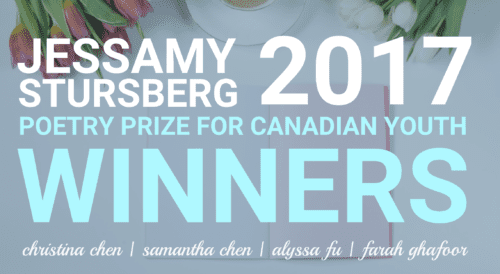
MEET THE POETS: 2017 JESSAMY STURSBERG POETRY PRIZE
Meet The Poets: 2017 Jessamy Stursberg Poetry Prize
Contest winners and finalists
Special recognition awards
Colleen Thibaudeau Award for Outstanding Contribution
Nominations are accepted in early spring. Winner announced during National Volunteer Week. Submissions are now closed.
The League is honoured to recognize the contribution of member volunteers through the Colleen Thibaudeau Outstanding Contribution Award. Established in 2012, the award is offered to a League member in recognition of a substantial volunteer project or series of projects that nurture and support poets and poetry across Canada. This award was established in memory of Colleen Thibaudeau (1925 – 2012), an Honorary Member and lifelong supporter of the League of Canadian poets, to show her support for the League, which was a source of friendship and recognition for her in her lifetime.
Nominate a poet here: https://airtable.com/appLhvrdbuBhKAbd3/pagJ9nqel41DbpB3F/form
Nomination letters should demonstrate the nominee’s ongoing commitment to supporting poets and poetry in Canada through volunteer contributions, such as operating a reading series, publishing chapbooks, participating on volunteer Boards, providing free editing or mentorship, etc.
Nominees must be current members of the League of Canadian Poets.
2025: Blaine Marchand and Joan Conway
2024: Daniela Elza
2023: Cornelia Hoogland and Flavia Cosma
2017: The Art Bar Poetry Series, Canada’s longest running weekly poetry-only reading series.
2016: Bruce Rice, for his invaluable efforts in establishing the now-annual Poetry City program and his longtime volunteer record with the League.
2015: Glen Sorestad, for his contribution to our annual Anne Szumigalski Lecture program and anthology, Measures of Astonishment, as well as his longtime volunteer record with the League.
2014: Allan Briesmaster, for his work in developing and executing the Poetry in Transit initiative, and his longtime volunteer record with the League.
2013: D.C. Reid, for his work in establishing the League Planned Giving and Bequests initiative, as well as his devotion to the League during his time as President.
2012: Wendy Morton, for her work in establishing Random Acts of Poetry, WestJet’s Poet of the Skies, and Chrysler’s Poet of the Road.
Find out more about past winners of the Colleen Thibaudeau Award here.
Lifetime Achievement Award
⋆⋆NEW⋆⋆
Launched in December 2024 with the support of a donation from poet Gregory Sass
Nominations are accepted from early December to early February annually. Winner announced during National Volunteer Week. Open to print poets and spoken word poets.
The League of Canadian Poets Lifetime Achievement Award is a $2,500 annual award presented to a poet to honour an outstanding body of work in Canadian poetry. The winner of this award is selected annually by a committee of three members of the League’s Board of Directors. The prize also includes recognition as a Life Member in the League of Canadian Poets, making them a permanent organization member.
This prize is open to spoken word poets as well as print poets.
Anyone can nominate an eligible poet for this annual award. Nominees will be contacted by the League and asked to provide additional materials (a CV and poetry sample) for review.
Nomination letters should demonstrate the nominee’s ongoing commitment to poetry in Canada through publication, performance, cultural engagement, and community engagement such as mentoring, education, events, and community organizing.
Please obtain permission from the person you’re nominating prior to sending your nomination.
Please also include an email by which we can contact your nominee, so that we may follow up to request additional materials for consideration.
To nominate a poet, email your nomination letter (max. 2 pages) to mary@poets.ca by midday on February 18, 2026.
Not sure how to start? Find a nomination letter template here.
Poets may submit to this award without a third-party nomination.
With your submission, please include:
- A CV (max. 5 pages) outlining notable publications, awards, events, performances, grants, and education (sample print CV, sample spoken word CV)
- A sample (max. 10 pages) of poetry
- Up to one (1) reference letter (max. 2 pages) from a colleague or peer in the poetry community
Poets who feel they would make a good candidate for this award may wish to approach a colleague or peer to request they submit a nomination. To make the process more straightforward, poets may supply this document as a starting point for a nomination letter. Such an email may look something like this:
Dear colleague. I'm writing you today to ask if you might submit a nomination letter on my behalf to the League of Canadian Poets' Lifetime Achievement Award. I've been grateful to [work with, collaborate with, learn with, exist with] you over the past several years, and your nomination would mean a great deal to me. I know you're terribly busy, so I'm attaching a nomination letter template here that you're welcome to use -- although of course you can write from scratch if you'd prefer! I have filled in some of the more general details you may wish to use in the letter. Thank you for your time and your continued professional and poetic support.
Submission materials may be submitted via this form or emailed as PDF attachments (maximum 3 attachments) to mary@poets.ca. Materials are due by midday on Wednesday, February 25, 2026.
Candidates will be evaluated using the following rubric:
- Body of work /20
- Craft
- Scope of work (e.g. development of craft over time, diversity of publishers/events)
- Quantity of work (e.g. number of books/feature performances)
- Cultural engagement (e.g. work's place in society and art)
- Consistency of work (e.g. clear dedication to craft, either as bursts of contribution or steady over time)
- Community engagement /20
- Mentorships
- Education and workshops delivered
- Community organizing work
- Event hosting and development
The new League of Canadian Poets Lifetime Achievement Award has been made possible through a generous donation by Gregory Sass. Gregory Sass has been a teacher, senior editor, television executive, and social worker. He is the author and co-writer of nine books. The leisure of retirement has given him the luxury to enjoy what he values: the silence within, sunrise and sunset, birdsong, reading, writing, quality conversation, being kind to whoever needs it, and supporting causes he believes in. Gregory’s newest book, Soul's Journey, is the poetic story of his own inner life lived during significant turning points in our time. It is an authentic, compelling tale of resilience, survival, and overcoming that leads to discovery of a life rich in meaning and loving relationships.
2025: Penn Kemp
Honorary Membership Award
Selected by the Board of Directors. Announced annually in June.
The League is proud to welcome new honorary members into our ranks each year. The Honorary Membership award is presented to distinguished individuals as a mark of distinction and appreciation for special achievements and contributions to the art of poetry.
2025 - Edmonton Poetry Festival, A Different Booklist
2024 - MQUP, Shelf Life
2023 - Theytus Books, HARC
2022 - Massy Books
2021 - McNally Robinson, knife | fork | book, Poetry in Voice
Life Membership Award
Selected by the Board of Directors. Announced annually in June.
Every year, the League is honoured to induct new Life Members into our ranks. Life Members are selected for their incredible contribution to poets and poetry in Canada, and the award is presented as a mark of distinction and appreciation for special achievements.
2025 - Gary Barwin
2024 - Sarah de Leeuw, Bänoo Zan
2023 - Clarice Foster, Joanne Arnott
2022 - Rita Bouvier, M NourbeSe Philip
2021 - George Elliott Clarke, Dionne Brand, John Barton
Sheri-D Wilson Golden Beret Award
This prize is no longer active. The last year it was awarded was 2021.
The Sheri-D Wilson Golden Beret Award was an annual literary prize crafted specifically to highlight the unique strengths and values of spoken word poetry, recognizing an established Canadian poet with a history of achievement and performance in spoken word.
2021 – Jillian Christmas
2020 – Charlie Petch
2019 – Andrea Thompson (Toronto, ON)
2018 – Dwayne Morgan (Toronto, ON)
2017 – d’bi.young anitafrika (Toronto, ON)
2016 – RC Weslowski (Vancouver, BC)
2015 – Penn Kemp (London, ON)
2014 – bill bissett (Toronto, ON)
2013 – Tanya Evanson (Vancouver, BC)
2012 – Kirk Miles (Calgary, AB)
2011 – Ian Ferrier (Montréal, QC)
2010 – Wendy Morton (Victoria,BC)
2009 – Lillian Allen (Toronto, ON)
2008 – Sarah Murphy (Calgary, AB)
2007 – Murdoch Burnett (Comox, BC)
Find out more about Sheri-D Wilson Golden Beret Award winners here.
Leon E. and Ann M. Pavlick Poetry Prize
This one-time prize was awarded in 2021.
The Leon E. & Ann M. Pavlick Poetry Prize was a one-time prize seeking to honour and encourage a Canadian poet whose work displays ample creativity and promise as well as an outstanding poetry group or collective with a positive and ongoing impact on poetry in Canada
In 2021, two prizes of $10,000 were awarded, to Andrea Thompson and Canthius. With an abundance of excellent applications, two runners-up prizes of $2,500 were also awarded, to Armand Garnet Ruffo and the Poets’ Corner Reading Series.
The Leon E. & Ann M. Pavlick Poetry Prize commemorates Pavlick’s Passages – a biography of Leon & Ann’s love story written in a unique poetic form – and the life and work of Leon E. Pavlick, who was a celebrated Canadian poet and member of the League. This award is made possible by a generous donation from Larry H. Mueller and Ann Pavlick in Leon’s memory. The League of Canadian Poets extends our exuberant thanks to Larry H. Mueller and Ann M. Pavlick whose contribution made this wonderful award possible. Through the Leon E. & Ann M. Pavlick Poetry Prize, we had the chance to provide a Canadian poet and a Canadian poetry group with funds to encourage their growth, furthering our organization’s goal of nurturing a professional poetic community in Canada. We are honoured to have had this chance, with thanks to Larry and Ann.
This prize is being awarded to Andrea Thompson because an investment in Andrea Thompson is an investment in the future of Canadian poetry. Thompson’s work will continue to change hearts and minds, and giving her the opportunity to focus on her own work will allow us all to reap the benefits when the work makes it out into the world. We are excited to see what Andrea Thompson will bring us next.
From the jurors: “It’s about time spoken word artists begin to receive the recognition they deserve. Thompson’s work is powerful and critical. I look forward to not only her new work but the inspirational ripples it will cause throughout the community.”
Read Andrea’s statement on winning the Pavlick Prize
Andrea Thompson is an artist. Her spoken word albums and performances have been critically acclaimed, and her work in Canada’s spoken word community has been foundational and trail-blazing. Throughout her career, she has dedicated herself to nurturing and supporting youth and emerging artists of all ages, sometimes putting her own work on a back burner to do so. With a passion for using poetry and performance as a tool for empowerment, Thompson has helped hundreds of vulnerable and disenfranchised students to develop their craft and literacy skills while increasing their emotional well-being and self-esteem. Throughout the 90s, she worked to help Canadian spoken word gain national and international recognition through radio, documentary, performance, and more. Learn more about Andrea at andreathompson.ca
This prize has been presented to Canthius to allow them not just to continue the great work they are already doing, but to encourage and enable them to push boundaries, working towards moving beyond the language of diversity and representation toward a truly equitable, joyful, and welcoming literary space. We look forward to seeing how this investment will enrich Canada’s poetry landscape.
From the jurors: “Only to explain difference must no longer be the requirement of our artistic labours. What is needed are avenues that can allow for exposure and examination with fullness, that gesture towards both criticality and care. Canthius is able to be one such avenue.”
Read Canthius’ statement on winning the Pavlick Prize
Canthius celebrates poetry and prose by women, trans men, nonbinary, Two-Spirit, genderqueer, and gender non-conforming writers. The magazine is published bi-annually, and over 8 issues, has displayed its committed to publishing diverse perspectives and experiences. Since its very first issue, Canthius has also committed to paying its contributors, before any funding had been secured. Their hard work and dedication to representation, diversity, and quality has seen them grow into a municipally- and provincially-funded literary magazine that highlights art, fiction, poetry, and non-fiction by some of Canada’s most historically oppressed communities. Their commitment to producing a beautiful print edition of the journal rewards readers and contributors alike. Learn more about Canthius at canthius.com
Runners up:
- Individual: Armand Garnet Ruffo
- Group: Poets' Corner Reading Series
Honorable mentions:
- Joelle Barron
- Cicely Belle Blain
- Louise Bernice Halfe – Sky Dancer
- George Elliott Clarke
- Michael Fraser
- Canisia Lubrin
- David Ly
- Tanis McDonald
- Faith Paré
- Melanie Power
- Cristalle Smith
- jaye simpson
- Phoebe Wang
The jurors for this award were Chelene Knight, Joseph Dandurand, and Zarmina Rafi.
Chelene Knight is the author of Braided Skin and the memoir Dear Current Occupant, winner of the 2018 Vancouver Book Award, and long-listed for the George Ryga Award for Social Awareness in Literature. Her essays have appeared in multiple Canadian and American literary journals, plus the Globe and Mail, the Walrus, and the Toronto Star. Her work is anthologized in Making Room, Love Me True, Sustenance, The Summer Book, and Black Writers Matter, winner of the 2020 Saskatchewan Book Award. The Toronto Star called Knight, “one of the storytellers we need most right now.” Knight was the previous managing editor at Room magazine, and the previous festival director for the Growing Room Festival in Vancouver. She founded her own literary studio, Breathing Space Creative, and she works as an associate literary agent with Transatlantic Agency. Chelene often gives talks about home, belonging and belief, inclusivity, and community building through authentic storytelling
Joseph A. Dandurand is a member of Kwantlen First Nation located on the Fraser River about 20 minutes east of Vancouver. Joseph is the Director of the Kwantlen Cultural Center. Joseph received a Diploma in Performing Arts from Algonquin College and studied Theatre and Direction at the University of Ottawa. He has just completed his residency as the Storyteller in Residence at the Vancouver Public Library. He sits on a committee for the Canadian Museum of History and is tasked with consulting on the redesign of the new Children’s Museum. He has published 13 books of poetry and the latest are: I WANT by Leaf Press (2015) and HEAR AND FORETELL by BookLand Press (2015) The Rumour (2018) by BookLand Press in (2018) SH:LAM (the doctor) Mawenzi Press (2019) The Corrupted by Guernica Press (2020) his children’s play: Th’owixiya: the hungry Feast dish by Playwrights Press Canada (2019) his book of short stories and short plays for children: The Sasquatch, the fire, and the cedar basket will be published by Nightwood Press along with his poetry manuscript: Here we come (2020-21) He also is very busy Storytelling at many events and Schools.
Zarmina Rafi is a Pakistani-Canadian writer, editor and curator. Following a ten year career in the visual arts, Rafi is currently a freelance editor with ECW Press. Her writing has appeared in Vallum, Arc, The Antigonish Review and filling Station. Rafi was a key member of the curatorial team of the first (2018) and second (2020) Lahore Biennales in Pakistan working alongside leading artists including John Akomfrah, Barbara Walker, Almagul Menlibayeva, Amar Kanwar and Shirin Neshat to name a few. Rafi has previously worked at the Art Gallery of Mississauga, KW Institute for Contemporary Art Berlin, School of Visual Arts BNU Lahore and at the Toronto Star. She is a grant recipient from the Ontario Arts Council, Canada Council for the Arts, KONE Foundation Finland, the Federal Chancellery of Austria, Sharjah Art Foundation and Tate Modern.